Friday, May 17, 2013

A tale of the male pannier or...a lost garment of the eighteenth-century.


Monsieur Fauteil! Your arm is in the way of my pannier! 

In his book “French Furniture Under Louix XIV,” Roger de Félice provided several illustrations of the shift from the earlier fauteuil, an open sided armchair, with its combined front leg and arm support to the separation of the front leg from the arm support to accommodate the pannier. He observed:

     “ ‘These panniers are a frame of Whalebone, or sometimes of wicker, covered with linen and put by women under their skirt, and by men in their coat-skirts, to keep them stiff and standing out.  The machine is considerably developed at each side of the wearer, bat (sic) very little at front and back, so that a lady from her slender waist and huge panniers looks like a washerwoman’s paddle.’  The poor woman bundled up with this were never able to find room in an arm-chair; so they were perforce reduced to chairs, as their great-great-grandmothers had been by their farthingales.  A gallant upholsterer in an ingenious turn devised the remedy; he set back the consoles of the arms, and the panniers could spread themselves at their own sweet will in front of the chairs.” 
(Roger de Félice,"French Furniture Under Louis XIV," Heinemann, London 1922. P. 135) 

Thirty years later Pierre Verlet wrote, again making note of the key relationship between costume and specially designed furniture:

     “The shapes [of  the chairs, furniture in general]  remained heavy, ample, and monumental.  They did lose some of their austerity, however, thanks to the rapid development of subtle undulations: the pediments of wardrobes began to curve, the legs of chairs and tables ended in goat's feet or sometimes volutes, the line of chair backs undulated more or less in an embrace, while seats took on a slight barrel curve.  Women's fashions alone would have forced menuisiers to revise their formulas, even if they hadn't wanted to: the fullness of the hooped skirts that came into fashion in 1718 obliged menuisiers to alter the location of the arms of their chairs, setting them back from the two front legs.  X stretchers between the legs tended to disappear, giving chairs a less constrained, lighter appearance from about 1720—30.“ (Pierre Verlet, (Penelope Hunter-Stiebel Trans.),  “French furniture of the Eighteenth Century,” University Press of Virginia, Charlottesville, 1991. p. 35)


Paniers à charnières, France, vers 1775-1780. © Les Arts Décoratifs / photo : Jean Tholance

Furniture builders adapted the armchair form to accommodate panniers, usually described as a woman’s undergarment constructed of wire or cane that widens the hips.  However, Felice also indicates pannier’s for men. While he does not name his source directly, he does acknowledge several sources in the beginning of his book. Thirty years later, Verlet notes the shift in arm placement, but only refers to women’s hooped skirts, or panniers, as the reason.  So why does Felice reference male panniers?  Did such an undergarment exist for men, or does pannier in this instance refer to the result, but not the mode? 

 London 1711

According to a reader of Addison and Steele’s Spectator, there are wires in the coat skirts of fashionable London men of 1711.  (The underlined section does not appear in the original, but is here for ease and emphasis.)

“Mr. SPECTATOR,
I and several others of your Female Readers, have conformed our selves to your Rules, even to our very Dress. There is not one of us but has reduced our outward Petticoat to its ancient Sizable Circumference, tho' indeed we retain still a Quilted one underneath, which makes us not altogether unconformable to the Fashion; but 'tis on Condition, Mr. SPECTATOR extends not his Censure so far.  But we find you Men secretly approve our Practice, by imitating our Pyramidical Form. The Skirt of your fashionable Coats forms as large a Circumference as our
Petticoats; as these are set out with Whalebone, so are those with Wire, to encrease and sustain the Bunch of Fold that hangs down on each Side; and the Hat, I perceive, is decreased in just proportion to our Head−dresses. We make a regular Figure, but I defy your Mathematicks to give Name to the Form you appear in. Your Architecture is mere Gothick, and betrays a worse Genius than ours; therefore if you are partial to your own Sex, I shall be less than I am now
Your Humble Servant.
T.”
--The Spectator, No, 145 August 16, 1711. Steele


Panniers, 1760, British, tan linen & baleen
From the Metropolitan Museum of Art

Paris 1720

In or around 1720, Jacques Rigaud (1680-1754) left Marseilles and traveled to Paris, where he created a series of engravings of the city’s environs.  Based on this success he then created a series of engravings of the royal palaces of France and in 1730 he was invited to England to create a series of engravings there.  These series of engravings display a cross section of dress within and across the social milieu during this period.  


Vue de la Bastille de Paris, de la Porte St. Antoine d’une partie du Fauxbourg by Jacques Rigaud
(Author’s collection)


Rigaud’s ‘Vue de la Bastille de Paris, de la Porte St. Antoine d’une partie du Fauxbourg’ of 1720 shows the St. Antoine gatehouse, one of the entrances to Paris, which was located next to the Bastille. (http://classes.bnf.fr/livre/grand/627.htm)  While there are a number of men in coats, two figures in the lower right of the engraving are of particular note.  Seated with their backs to the viewer their coats display an odd shelf, which seems to resemble a posterior pannier.  It appears that some type of form holds the backs of the coat skirts in a rigid manner.  How is this form maintaining its shape under the weight of the fabric and the positioning of the bodies?  Is this the pannier that Roger de Félice references?  It may be contrived, but it seems an odd affectation in an otherwise mundane view of travel and commerce. The images above and below are from the engraving. 


To date, any examples that I have found of early 18th century male coats note an inner layer of buckram or horsehair, but no other forms of manipulation.  This engraving seems to indicate that more yjan starched lining is being used to create a panniered appearance.  So where have all the wires and whalebone gone? 

The history of the male pannier has been considerably shrouded, perhaps in part because so few examples remain extant - coats were costly, constantly updated to the current styles, wires removed and stiffners relaxed. As I have discovered, the fullest accounts appear in relation to furniture adaptations or in prints. It appears that this form of male attire occurred primarily in the first half of the eighteenth century, paralleling that of women's fashions.

Jeff Hopper writes about historic men's garments for Silk Damask.

This is excerpted from a forthcoming article.

Thursday, May 2, 2013

Madeline's (Very) Orange "Flapper" Wedding Dress, 1928


Madeline Sirois Parker
Married in Fort Fairfield, Maine, February 20, 1928


Madeline Sirois Parker loved color. Living in Aroostook County Maine, the sunny days were revered and often called for excursions to pick fruit and enjoy a picnic.   She loved her flower garden and had not only a green thumb but a true sense of color, embodied in her orange “flapper” wedding dress, currently on view at the American Textile History Museum as part of the exhibition Behind the Veil. Madeline’s personality shines through her wedding dress selection. According to her granddaughter, Janith Bergeron, Madeline was always a very “colorful” person. Since Madeline lived in a very rural area of Maine, she purchased the fashionable dress in Canada. Spring was still far off, so she chose to wear a bright and colorful dress, rather than blending into the white on white of  winter. While a foggy wedding day may have concerned some soon-to-wed couples, it caused her groom, Lester Parker to comment that he was glad he could see her through “the weather.” Unfortunately, no wedding photographs were taken so we cannot see how stunning she looked in her shimmering flapper dress – although one can surmise she was beaming!


The dress was (and is) eye-catching. It no doubt had a slight orange glow from the light silk. With its uneven hemline, typical of the period, and its glimmering beads and sequins, outlining the low waist and trimming the sleeveless garment, Madeline would have been stunning on her wedding day. Her matching hat completed the ensemble. One senses she exuded confidence, for not every bride would feel comfortable making such a bold statement.

Janith (a skilled designer and inspired seamstress like her grandmother) recalls:

“sewing was a passion and I remember many days spent in her lovely sewing room which looked out onto the potato fields and the mountains on the other side of the St. John River. Madeline was a wonderful hat maker...she would create lovely ensembles of all kinds and then a hat to go with them.   Ladies did not go without hat and gloves.   Any trip to town was an occasion to dress (and I mean 'to the nines'). Madeline often did sewing for a dress shop in town...Avis's dress shop, Fort Fairfield, Maine.   It was a very popular place with garments often coming from Europe and Canada. And, oh, she was also a great cook and I'm happy to say I still have her cookbook.” 

Correspondence between the author and Janith Bergeron, April, 2013.
Janith Bergeron is proprietress of Designs By Janith and Co-Director of The Sewing Tree, Dover, New Hampshire.
The Sewing Tree
Designs by Janith

Photos of Madeline's dress below are courtesy American History Textile Museum; Frank Graham, photographer.


### #### #### ####

For more stories about brides and their weddings, visit

American Textile History Museum
www.athm.org/
April 6, 2013 August 11, 2013
Whether extravagant or frugal, traditional or fashion-forward, the story behind a bride’s dress has much to tell us about her life as well as our common culture. A symbol of love and commitment, the wedding dress personifies girlhood fantasies, a moment of transition, a performance of cultural values. Behind the Veil: Brides and Their Dresses explores how brides over the past 100 years have chosen their wedding dresses, and how their decisions are shaped by fashion, family, and finances. This exhibition highlights not only the dresses worn on the big day, but the stories of the women who wore them – whether a traditional princess-style dress or a funky animal print, whether a simple homemade dress from the early 19th century or a mini worn in 1969. How have women created alternatives to the iconic white dress, or how have they embraced the fairytale wedding? More than an historical survey, this exhibition explores generations of women and the stories of their bridal attire.


Friday, April 19, 2013

A Summer Surtout, c.1760s


Paris,  Friday 11 July 1760, heading for that special enlightenment salon this evening, but it’s too warm for a complete habit à la française. Why not try the demi-habit this summer and stay cool as the champagne fizzes and the bon mots sizzle?

This 1760s man’s coat sold at the Hotel Drouot in Paris in 2010. The fabric is a lightweight striped silk taffeta in shades of green and pastel pink; it has wide lapels and an attached vest. (Some of the buttons for this garment are missing.) The two front sections of the vest are sewn directly to the armholes of the coat, so there is no back to the vest, just the coat itself. 

According to the auction catalog, this is a rare example of a coat for the summer or the French Colonies.  This utilitarian combination allows for a degree of formality while alleviating a least one layer of clothing. Oddly, this appears to be more akin to a formal banyan, if such a creature ever existed, than a day coat. Makes one wonder at the number of novel solutions for comfort and conformity lost to time.


Below, find an example of a banyan created from a blue dragon robe with a matching long sleeved waistcoat, which also straddles the formality line. 

Finally, another example of a banyan, but more in keeping with the "accepted" idea of the style. This brown woollen damask garment, c. 1739-41, is from the Museum of London.


I would like to thank Alain Truong for the use of the photograph of the striped silk coat, as it was the only copy that worked for me.  His blog archive is:

Jeff Hopper writes on men's fashions, past and present for SilkDamask. Previous blog posts may be found on the site.

Thursday, April 11, 2013

Homespun & Handsewn: A Boy's Sailor Suit, c.1850


This charming two-piece sailor suit is from the textile collection at the Strawbery Banke Museum in Portsmouth, New Hampshire, USA. The records are currently silent on the provenance of the ensemble, so nothing is currently known about the family or maker or wearer of the simple, but well-crafted shirt and trousers. Nonetheless, it has the ability to conjure up images of New England’s long relationship with the sea and the maritime trade. Made of homespun and entirely hand stitched, incredible care went into its planning from the hand stitched blue, denim-like collar to the two milk glass buttons of the drop front trousers. Even the shirt ties are placed with care. It is dated circa 1840-1850 based on men’s clothing of the time. When placed on the mannequin, the little sailor assumes a jaunty, playful air.
The three piece English sailor suit below is from slightly later in the 19th century (Courtesy Los Angeles County Museum of Art @LACMA)
Boy's sailor suits will continue to be popular through the Edwardian period but they are generally of finer fabrics, such as blue velvet, often with trimmings and fancy buttons and do not bear the same sense of "activity" conveyed by the Strawbery Banke example. (An example of an Edwardian, c. 1912 sailor suit may be found at http://bartoscollection.com/boy02sailorsuit.html)


Mannequin, Astrida Schaeffer, Schaeffer Arts
Image, courtesy Strawbery Banke Museum
Photograph, Tara Vose Raiselis
Exhibited:“Through the Eye of the Needle: Family Stories, Sewing Stories” Portsmouth Athenaeum, Winter 2009; "Thread" Strawbery Banke Museum 2012.

Saturday, April 6, 2013

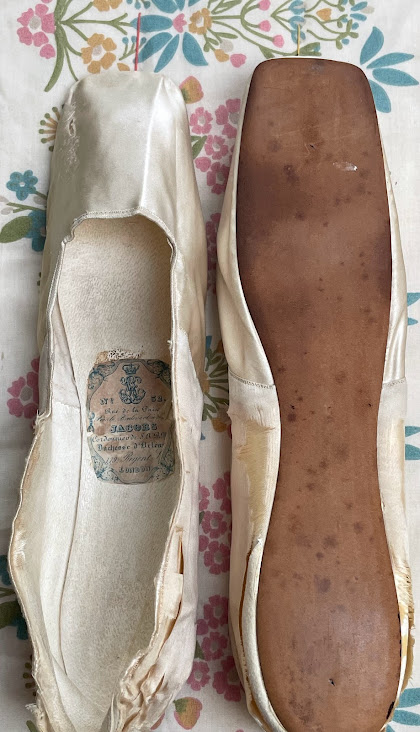
Mary Eliot Dwight's 1849 Wedding Slippers: Vaughan Homestead, Maine


Jane Radcliffe and Ron Kley of Museum Research Associates (MRA), recently discovered this elegant pair of wedding slippers while conducting ongoing research at the Vaughan Homestead in Hallowell, ME. According to MRA, they are part of the May 7th, 1849 wedding outfit of a mid-19th century proper Bostonian -- Mary Eliot Dwight (She married Dr. Samuel Parkman and became the mother of Ellen Twisleton Parkman, who married William Warren Vaughan).


These simple, elegant Parisian white satin slippers were extremely popular among brides at mid 19th century, perhaps in part due to Queen Victoria's slipper selection for her 1840 wedding. (Of course her slippers were English made by Cundry & Co. See earlier post: 
http://silkdamask.blogspot.com/2012/09/whats-in-label-3-queen-victorias-1840.html) Similar foot apparel has survived in dozens of historic garment collections. This is not surprising as they are important emblems of significant events. Shoes and other accessories, such as stockings, hats, and gloves were fairly easy to store - much more so than an elaborate wedding dress. Mary Dwight's wedding slippers are of particular interest, however, as key elements of a well documented wedding ensemble. As MRA astutely observe, the charming and diminutive proportions of the (apparently original) pasteboard box in which the shoes were found (and on which their history is inscribed) is as interesting as the shoes themselves. The handwriting on the box notes "Shoes & stockings worn with my wedding dress..."

The slippers feature a square toe, interior kid lining, and dainty silk ribbon set within a channel. I have not seen the sole, but I believe them to be straight last (no right or left). It was not uncommon, even at this late date, to use straight lasts for special occasion shoes. By the mid-19th century, the last Paris shoes could be purchased in any sizable Northeast city.
The shoe label is particularly attractive - research is currently underway on the designer.

Other lesser known examples are in numerous collections such as these found in the Irma Bowen Collection at the University of New Hampshire. It has no known provenance.
The ballet flat or slipper style remains popular to this day as may be seen in the work of designers such as Emma Hope, who got her start designing ballet flats for Laura Ashley.

With wedding season upon us, sharing this graceful footwear from the past seems appropriate.
The author thanks Museum Research Associates, the Vaughan Homestead Foundation and Astrida Schaeffer, of the Irma Bowen Collection, for generously sharing this images and information on New England footwear.

Tuesday, April 2, 2013

Lytton Strachey and Freddie Mercury Opine on the Victorian Age


The excerpt below is taken from the Introduction, by Kimberly Alexander, Ph.D., for Embellishments: Constructing Victorian Detail  (Astrida Schaeffer, Great Life Press, forthcoming June 2013)

The history of the Victorian Age will never be written: we know too much about it. --Lytton Strachey

Lytton Strachey (1880-1932), a founding member of the Bloomsbury group of writers and intellectuals, and author of Eminent Victorians (1918) and Queen Victoria (1921), was certainly in a position to make this claim.  Strachey’s enigmatic conclusion was not off the mark, and the Victorian influence that came to define the late nineteenth century remains an epoch that confounds historians and scholars. For the modern audience, the term “Victorian” is one which implies much and reveals little simultaneously.  It conjures up an image of “being surrounded by exquisite clutter,” as Freddie Mercury of Queen memorably described in 1977.  


The nineteenth century certainly was a period of cultural clutter, as the three sisters of modern life--industrialization, immigration, and urbanization--excited and disturbed the rhythms of society and family.  But, it was fashion that most powerfully organized the clutter, both triggering and mirroring the “tyranny of change,” as one historian has described this maelstrom of unsettling forces.  Singer’s sewing machines enabled women to experiment with trends inside the home.   The Delineator and other design journals excited their hopes and guided their hands by introducing Chicago and Omaha to current patterns from Paris and London.  Godey’s Ladies Book and other magazines that catered expressly to woman and inspired them to develop themselves as domestic paragons.
Catalogues like those of Sears, Roebuck allowed them to make purchases from virtually anywhere in the United States.

It is no small irony, then, that the figure whose name represents this period of exquisite clutter presented herself as an adamantine force of tradition and decorum.  Queen Victoria would be Britain’s longest ruling monarch, ascending the throne in 1837 and holding court until 1901.  But, it was marriage in 1840 to Prince Albert of Saxe-Coburg and Gotha that marked a dramatic shift in the idea of fashion.  Not unlike the royal weddings of today, her dress was watched carefully--on both sides of the Atlantic.  Designed by William Dyce and stitched by Mary Bettans, the gown was a simple dress, of Honiton lace and silk satin, and, notably, white, inspiring a tradition in wedding fashion that persists to this day.  Godey’s editor Sarah Hale saw an opportunity here, and filled the magazine with Lydia H. Sigourney’s accounts of court life in London that inspired American women to imitate a royalty that their politics denied them.


    The historic garments captured here, many published for the first time, date from the late Victorian period, roughly 1875 until 1909.  As such, they reveal complications of nationalism and homage to European trends in fashion, like warp and weft, that Americans found displayed in the great exhibitions of their day.  The fashion of the Gilded Age, on the eve of the 1876 American Centennial Exposition in Philadelphia, are not as distant from the direct influence of Queen Victoria’s court and Parisian haute couture as one might expect........&.


Kimberly Alexander, Ph.D.
University of New Hampshire
Durham, USA


Cover design: Great Life Press
Images: Brian Smestad, Astrida Schaeffer
Courtesy, University of New Hampshire, Irma Bowen Collection